Although I’ve built a number of model planes (which were mostly foam), I was curious to expand my horizons and try to build a model boat.
Surprisingly, the model boat community involves more copyrights than other building communities I’ve experienced, and you therefore need to pay for many plans. I was also surprised by the limited documentation for people new to the hobby. Here’s my attempt to give you a quick introduction.
I wanted to choose a very simple boat to build first. Given the copyright issues, I found a plan for a simple torpedo boat. I didn’t want to worry about the fancy parts, but instead build the primary hull shape.
By cutting out the forms in simple Dollar Tree foamboard, I was able to build out the basic shape and get a sense of how everything fit together.
This was possible with only:
- Foamboard
- Hot glue gun
- Utility knife
- Pins
I could have finished and waterproof this proof-of-concept with plastic or chemical sealants, but decided to switch to wood. Here’s a pic of the foamboard mockup and its later evolutions in wood:
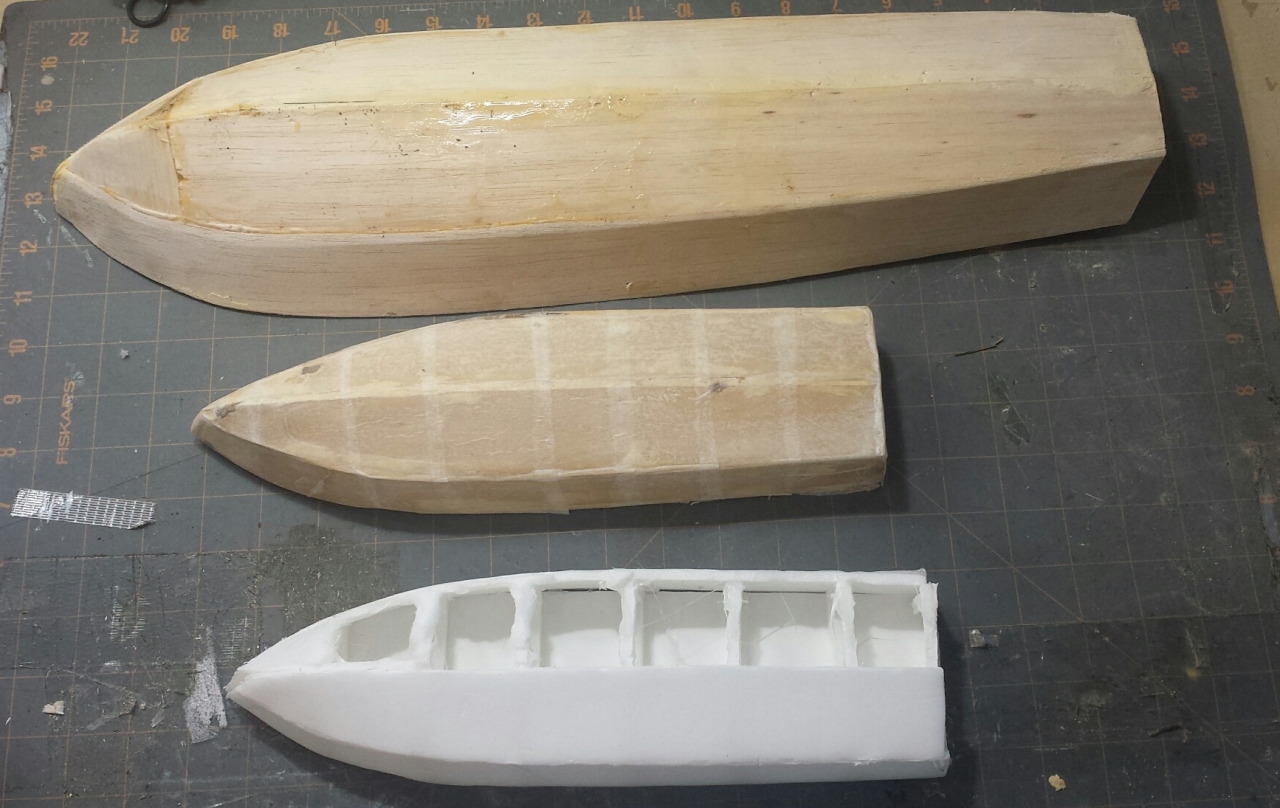
Most hardware stores have a stash of basswood and balsa. I initially bought basswood, but then switched to building with balsa. I used the plans from this boat: http://eezebilt.tk/PTBplan.pdf
There is a great tutorial on this here: http://eezebilt.tk/PTB1.html
Materials:
- spray adhesive (spray lightly on the wood and then attach the plans. Makes cutting out the forms really easy)
- pins (lots and lots of pins)
- sandpaper (and learning the difference between grits)
- glue (elmer’s wood glue)
- respirator (for sanding)
Once the hull is finished, it’s time to waterproof it. Apparently this is a very common method (I’m still experimenting): http://www.building-model-boats.com/tissue-and-dope.html
Key learnings from these initial forays:
- boats are basically composed of three systems: the power system (motor or sail), the physical structure (the hull), and the chemical structures (the waterproofing of the hull).
- Wood matters. For example, because of how wood grains works, it was important to cut across the grain first, then down the grain. Otherwise the wood will split. (there is the Janka scale to compare wood hardness)
If you want to dive deeper, there are some good materials online but I recently picked up this book:

Pinterest has some great materials if you do a search on “model boats”. One word of caution: You should explain your true intent to your significant other (some of the results will show “models” on “boats”).
Here’s a good sailboat option.
Eventually, you can go big and build a full-size boat (such as a Cartopper or canoe)
TAP Plastics can help you get up to speed on fiberglass and other resins (check out their videos).